
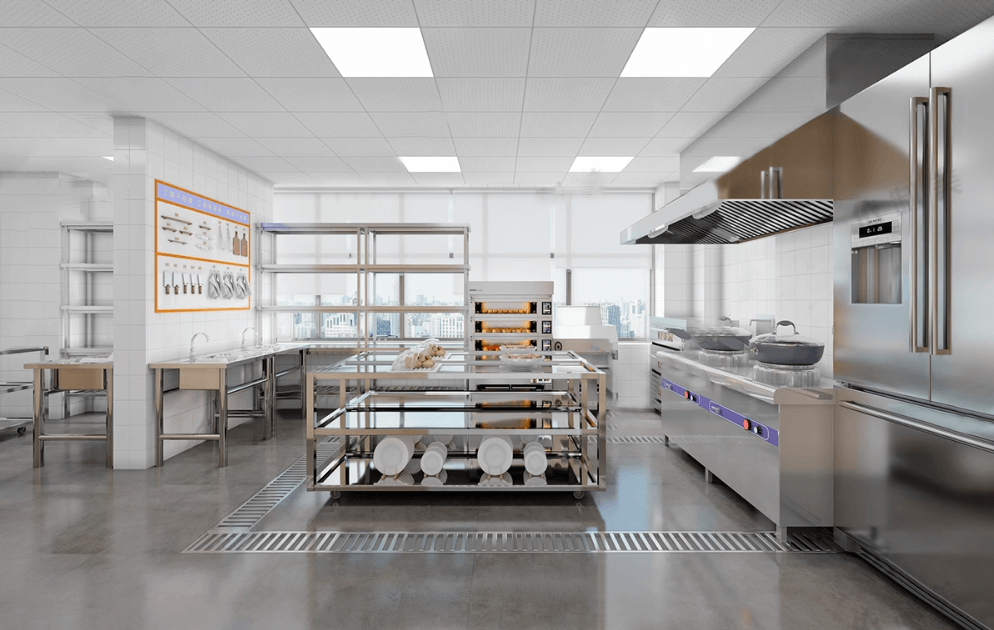
A precise definition of a commercial kitchen is similar to the dining halls and canteens found in factories, schools, government offices, military units, hospitals, enterprises, institutions, trains, and ships. These kitchens are large-scale, capable of serving multiple customers simultaneously. They consist of small, functional work areas. Each area or small kitchen has a clear division of labor and is coordinated to handle the large-scale production work of the company or hotel.What is commercial kitchen equipment engineering?
Commercial kitchen engineering encompasses the production, installation, and after-sales service of kitchen equipment, as well as collaboration with other professionals. Kitchen equipment engineering primarily requires attention to the specific requirements of the Food and Drug Administration, Fire Department, and Environmental Protection Agency for kitchen areas. Furthermore, other professional disciplines (such as HVAC, electrical, and plumbing) have their own standards and technical specifications. The construction process requires coordination with and addressing all of these requirements.
Kitchen engineering design refers to the relevant design of the kitchen area during the planning stage of a catering project, mainly including kitchen equipment layout, kitchen water supply and drainage, electrical potential, gas points, smoke exhaust, etc.What is commercial kitchen equipment engineering?
Commercial kitchen project design is a link in the commercial kitchen project and an important link, because only after the kitchen design is completed can the kitchen equipment be purchased according to the design plan, and then construction can be carried out (including site infrastructure, equipment delivery, installation and commissioning, and overall acceptance).
Many people consider kitchens to be messy places, especially in public or commercial settings. They are a taboo for businesses to allow outsiders into their kitchens. However, with the development of society, people are paying more and more attention to food safety, and kitchens are becoming more transparent. Some catering companies have introduced “transparent kitchens” or “open kitchens,” allowing customers to monitor the chefs and the kitchen environment in real time. A clean, tidy kitchen with a well-designed, low-noise, and energy-efficient design undoubtedly attracts many customers.
Only a well-designed commercial kitchen can meet the professional and personalized needs of the enterprise. Therefore, the design of the kitchen is very important!
First, determine the efficiency of the workflow. Although the drawings don’t include specific workflows, the planning and design are based on the principle of process sequencing and incorporate it throughout. The efficiency of the kitchen’s workflow is primarily determined by its layout. Planning and design must be carefully analyzed to reduce steps, shorten distances, and streamline processes for a smooth and efficient process. Kitchen layout design is a soft science, relying primarily on operational thinking and design techniques. It can optimize kitchen functionality and improve efficiency without requiring additional investment.What is commercial kitchen equipment engineering?
Second, determine the design of the auxiliary systems. All aspects of the design process are organically interconnected. Area division, aisle arrangement, workshop division, equipment layout, and auxiliary facilities such as utilities, smoke exhaust, and so on are closely intertwined. Changes to one will impact the others. Once the kitchen’s structural dimensions are determined, the equipment determines the size of the workshop, which in turn determines the area divisions, which in turn constrains the aisle arrangement. If the equipment layout changes, auxiliary facilities such as utilities, electricity, and smoke exhaust must also be adjusted accordingly. This requires repeated consideration and multiple adjustments; it’s impossible to achieve a perfect solution in one go.
Third, determine the kitchen’s intended functions. These functions are primarily determined by its layout. Kitchens come in all sizes, but essential functions are essential. A kitchen that’s too small wouldn’t be suitable for a workshop. However, the functional aspects of the design must be considered, and the design should follow the workflow and process steps, ensuring that no steps or items are overlooked.What is commercial kitchen equipment engineering?
Product Video:  Follow us on Facebook
Product Category
| >Cooking Equipment | >Refrigeration Equipment | >Bakery Equipment | >Food Processing Equipment | >S.S. Furniture
| >Food Display Equipment | >Snack equipment | > | >Furniture | >Small Wares